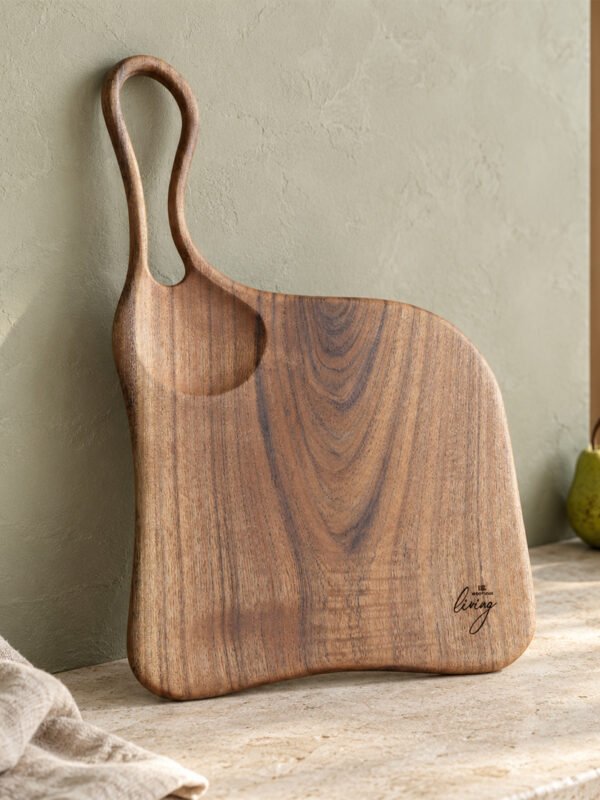
Close your eyes and imagine a room made entirely of plastic, metal, and glass. Now imagine a room made of wood, stone, and plants. Don't think too hard about it—just notice the feeling.
One feels cold. Sterile. Active. Stimulating.
The other feels grounding. Alive. Calm. Like thinking is possible.
This isn't sentimental. This is neuroscience.
Biophilic design—the principle that human beings are wired to respond positively to natural materials and living systems—has decades of research behind it. Rooms with natural materials reduce stress, improve focus, and increase creative output compared to rooms with synthetic materials.
But the research doesn't capture the actual experience of working with wood. The actual feeling of your hands on a wooden desk. The actual difference it makes to your thinking.
The Science of Biophilic Design
The research is worth knowing about, not because it justifies the choice—you don't need science to know that wood feels better—but because it validates what you already sense.
Exposure to natural materials lowers cortisol (stress hormone) and increases parasympathetic nervous system activation (the relaxation response). Just looking at wood, compared to synthetic materials, produces measurable physiological changes.
Natural materials have fractal patterns—patterns that repeat at different scales. Your brain finds these patterns deeply satisfying. They're everywhere in nature. Trees, coastlines, clouds, even your own blood vessels. When your brain encounters fractals, it calms. It recognizes: this is right. This is natural.
Wood has variation—grain patterns, color shifts, subtle differences from one board to another. Your brain finds this variation engaging and satisfying in a way that uniform, synthetic materials aren't. Variation keeps attention without demanding it. It's interesting without being overwhelming.
Temperature matters too. Wood holds temperature differently than metal or plastic. It stays slightly warmer to the touch. This warmth triggers the parasympathetic nervous system. It signals safety.
All of this happens at a level below consciousness. You're not thinking about fractals or cortisol levels. You're just noticing: I think better when I work with wood.
Why This Matters for Your Desk
Your desk isn't background. It's not a neutral platform. It's something your hands touch thousands of times. Something you look at for hours every day. Something that's constantly communicating to your nervous system.
If that desk is made of particleboard with laminate finish, it's sending a message at every touch: this is synthetic. This is mass-produced. This is temporary. Your nervous system believes that message, and it affects how you work.
If that desk is made of solid wood, finished to bring out the grain, aged to show its character, it's sending a different message: this is real. This is made with intention. This is built to last. This matters.
Your hands know the difference. Your eyes know the difference. Your brain knows.
And the work you do at a wooden desk is simply different than the work you do at a synthetic one. Deeper. More thoughtful. More itself.
The Imperfection Factor
Here's something most design advice gets wrong: it treats imperfection as something to minimize.
Flaws should be hidden. Variations should be uniform. The goal is invisible perfection.
But natural wood refuses this. A wooden desk has knots, color variations, grain patterns that aren't perfectly symmetrical. Some of these are beautiful. Some are quirky. None of them are mistakes—they're evidence that this was a tree, with its own character, now become your desk.
This imperfection is actually where the magic happens.
When you look at perfect uniformity, your brain disengages slightly. It's not surprising. It's not engaging. It's pleasant but ultimately boring.
When you look at natural variation and imperfection, your brain stays engaged. It notices. It's interested. Over years of looking at that desk while you think, those imperfections become part of the landscape of your thinking. That knot in the grain, that color shift—they become anchors. They become the visual texture of your creative life.
Imperfection makes it real. It makes it yours.
Temperature and Texture
Go put your hand on a plastic desk and a wooden desk. The difference is immediate.
Plastic—especially laminate—is cold to the touch. It doesn't change temperature. It's static. Inert.
Wood is warm. It responds to temperature. In winter, it's slightly cooler than plastic in a heated room, but it feels warm in a way that plastic doesn't. In summer, it's slightly cooler to the touch. It has responsiveness. It has life.
Texture matters too. Plastic is smooth in a way that feels artificial. Wood has subtle texture—grain ridges, imperfections, variations that your fingers register. That tactile information is grounding. It brings you into your body, which brings you into presence.
Your hands spend hours on this desk. That tactile relationship shapes your experience of working there.
The Aging Factor
This is the part most people miss: a wooden desk gets better with time.
The finish develops a patina. Wear marks appear where you rest your hands. The color deepens and shifts. Small scratches and dents accumulate—each one a story.
A wooden desk at twenty years is more beautiful than a wooden desk at two years.
A plastic desk at twenty years is more worn out.
There's something profound about working at a desk that improves with age. It says something about your practice. It says you're in this for the long haul. It says the work is building, not just happening.
And practically, it means your investment actually increases in value over time. Your desk becomes an heirloom. Your children might work at this desk someday. That thought changes how you treat it. It changes how you sit at it.
Choosing Wood
Different woods have different personalities.
Walnut is deep, serious, grounding. It's dark enough that grain patterns show clearly. It ages to beautiful silver-grey. Walnut feels like deep thinking.
Oak is lighter, with more pronounced grain patterns. It's active, energetic. The variation is obvious. Oak feels alive.
Ash is pale, fine-grained. It's subtle. Light. Good for offices where you need clarity without drama.
Teak is warm, with its own golden-brown character. It's durable and ages beautifully. It feels intentional.
Every maker will have preferences. Talk to them about which wood makes sense for your work. Some people think better at walnut desks. Others need the lightness of ash. Let your intuition guide you. Your body will know which wood supports your thinking.
Living With Wood
A wooden desk requires something from you: attention.
Not obsessive attention—you're not treating it like a museum piece. Just the kind of attention you'd give something valuable. Occasional oiling, attention to spills so they don't stain, keeping it away from direct heat or intense humidity.
That care becomes part of your relationship with your desk. That monthly oiling, where you really look at how it's aging, where you feel the wood respond—that's not maintenance. That's relationship. That's respect.
Why Wood Transforms How You Think
It's not magic. It's not even that mysterious.
Working with natural materials—especially wood—keeps you grounded while you're thinking. It keeps you connected to something real. It signals that your work deserves real, not synthetic, support. It shows you that your environment is invested in your success.
Over months and years, that transforms how you think.
You think more deeply. You're less rushed. You're more willing to sit with a problem because the space gives you permission to. You finish work because the space reminds you: this matters.
Wood does that. Natural materials do that.
Bring wood into your workspace. Feel the difference immediately. Notice over months how it shapes your thinking. Over years, watch it become woven into your practice.
That's not sentimental. That's the physics of attention, the neuroscience of calm, the philosophy of real things supporting real work.